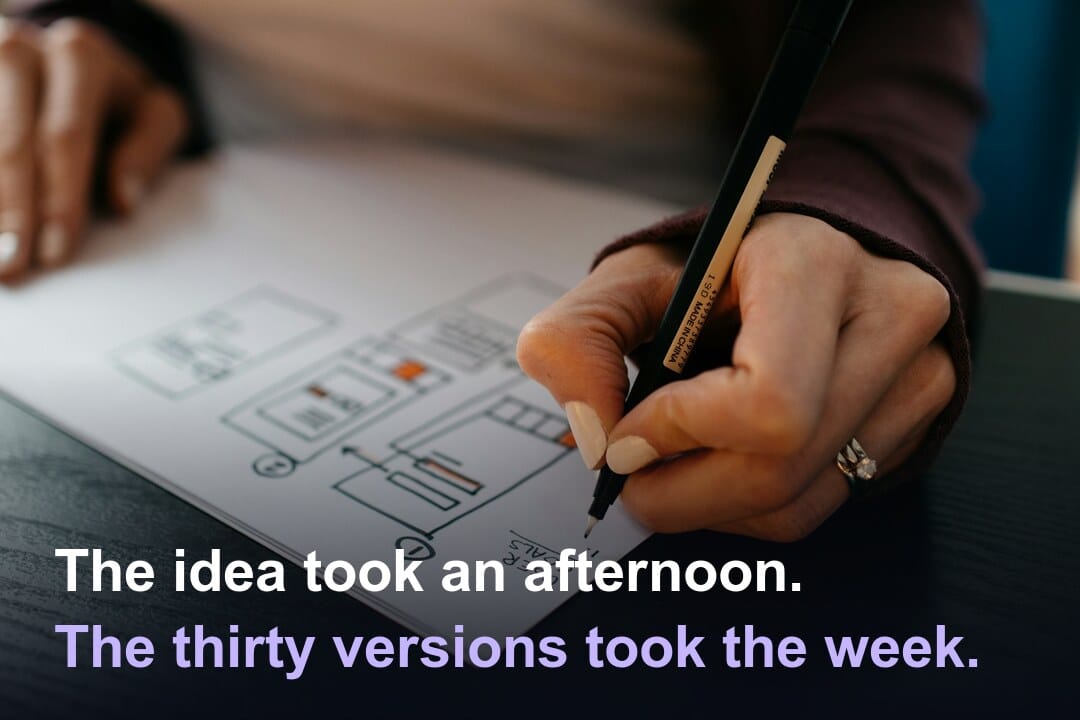
You did not get into this work to resize the same banner into thirty placements. You got into it for the idea, the first time a layout finally clicks, the campaign that makes someone feel something. Yet most weeks, the idea takes an afternoon and the thirty placements take the rest of the week.
That gap is what designers and creative leads are quietly closing in 2026. The shift has a slightly clinical name, agentic editing, but the feeling behind it is simple. You stop doing every repetitive edit by hand and start directing a small crew of AI agents that handle the long tail, so your hours go back to the part only you can do. Full disclosure before we go further. Layermetry is one of the tools built for this, so we have a stake in the idea. We are going to lay out what changes, what stays yours, and how to think about the move, then let you decide what fits your team.
Why this is happening now, not as hype
In a 2026 industry survey of 906 designers, about three in four now use AI every day, and the average designer reaches for around seven AI tools regularly, more than double the three from a year earlier. In that same survey, 91% said new AI tools improve their designs. That is not a forecast. It is what is already on people's desks.
From doing the work to directing it
The more interesting change is not how many tools designers use. It is the posture. Creative leads are starting to describe their job less as making each asset and more as guiding a system that makes the assets. One brand lead quoted in a 2026 design report calls these designers "Agent Captains," people who oversee agents handling production while they hold the strategic what-ifs. The word that report keeps returning to is orchestrator. You set the vision and the standard, and a layer underneath you carries it out.
The honest version of the trend
None of this means the work got easy or that the craft stopped mattering. The pattern designers describe on real client jobs is consistent. The tool gets you a chunk of the way in minutes, and the remaining stretch, the part that understands brand context, audience and intent, is where the design actually lives. Agentic editing does not touch that last stretch. It clears the road in front of it.
What an agent is, in plain terms
Two words are doing a lot of work in this post, so let us ground them without a lecture.
If you have asked a tool to turn a prompt into an image, or used a chat assistant to draft a caption, you have already used generative AI. It produces something from a description. An agent is the next step. It is that same kind of model given hands, the ability to actually take actions in a tool and check its own results, rather than just describe what it would do.
Generative AI describes or makes the asset. An agent does the work on it: crop, retouch, reframe, color, export, then checks the result and keeps going. Agentic editing is a small team of those agents working through a brief together, with you directing.
Editing turns out to be a near-perfect fit for this. So much of finishing work is already a sequence of nameable actions. Crop this, match that color, reframe for vertical, swap the logo lockup, export six sizes. Agents are good at exactly those steps. The part that is not a nameable step, deciding whether the whole thing feels right, is the part that was always yours.
What agents are genuinely good at
The clearest way to see the line is to look at the work itself. Agents earn their place on the repetitive, nameable, high-volume end.
The long tail of finishing work
In 2026, the production tasks creative teams hand off look like this. Resizing and batch adaptation across formats. Headshot cleanup and product-shot variations. Background removal, object removal and reframing for different aspect ratios. Versioning a single piece into many languages or placements. A round-up of AI agents for creative teams describes agents taking on this multi-step work from a plain-language brief, while the same piece is blunt that the best creative is still built on human judgment and brand strategy.
A real day, before and after
Picture a launch film that has to ship in ten markets. The old way, you open the project ten times and walk each version through the same reframe, color pass, caption swap and export. Same goal, same hands, ten times. The agentic way, you brief it once, a crew of specialist agents fans out across the ten, and you review the batch and fix the two that need your eye. The judgment calls are still yours. The repetition is not.
If your own work fans out like that diagram, one brief becoming many near-identical outputs, that is the signal that the long tail is worth handing off. If most of your work is one-of-a-kind and never repeats, you may not need this yet, and that is a fine answer too.
What stays human, and why that is the good news
Here is the part worth slowing down on, because it is easy to read a trend like this as a threat.
Taste is harder to automate than people expected
A generated layout can look polished and still quietly miss the emotional nuance, the cultural read, the brand personality. The tools move pixels well. The thinking part, knowing what to make and what to leave out, is still the job. In that survey of 906 designers, the most-named markers of craft were visual polish, thoughtful problem-solving, intuitive experience, and emotion and delight, the things you cannot hand to a checklist.
The hero work stays yours
What agents are bad at is the stuff that needs judgment. Taste, intent, whether something feels right for the brand. That is exactly the part you want a person holding. The repetitive long tail is the scaled, nameable work. The hero campaign, the brand-defining piece, the moment where taste is the whole point, does not get handed off, because handing it off would defeat the reason it exists. The pattern many creative leads describe is that generic, execution-only output is getting cheaper while taste-led, human-directed work becomes more valuable. Agentic editing is not the thing replacing your judgment. It is the thing buying back the hours so you have more room to use it.
Why the numbers lean calm, not catastrophic
It is reasonable to feel wary. The honest read of the data, though, is steadier than the headlines. In that same 2026 survey of 906 designers across several regions, the people using AI were 25% more likely to report job satisfaction than those who were not, and a majority said their relationship with their own work improved. That is one survey, not a law of nature, and plenty of designers report friction too. But the direction is consistent. When the repetitive work lifts, people tend to like the work that is left.
How to make the move without fear
You do not have to reorganize your whole practice this quarter. The teams who land this well tend to start small and stay in control.
Pick one nameable task
The most repeated advice in 2026 is to choose a single repetitive task and route that one to agents, rather than automating everything at once. Pick the chore you could explain to a new hire in two sentences. The thirtieth resize. The same finishing pass across a library. The version-for-every-market grind. Hand that off first, watch the first batch closely, and grow from there.
Keep your hand on the standard
Directing a crew of agents is not the same as walking away. You still set the brief, you still approve the batch, and you still own the call on whether it is good. The shift is from doing every step to defining what good looks like and checking that the work meets it. That is closer to art direction than to production, and most creative leads find that trade worth making.
Decide build, adopt, or stay manual, honestly
There are three real paths, and each has an honest cost.
- Keep doing the long tail by hand. Total control and no new dependency, at the price of your hours.
- Build your own agent setup. Maximum control, and a lot to maintain forever. Changing one agent or one model can shift the whole flow, so the watching becomes a standing cost rather than a one-time build.
- Adopt an off-the-shelf layer. You trade some control for speed and far less upkeep. Layermetry is one of those layers, with classic, generative and agentic tools in one place, so you can mix the manual and the automated rather than choosing a side.
None of these is right for everyone. The right one matches how much your work repeats and how much you want to own underneath it. The docs go deeper than a post should.
The shift, in one line
The machines are getting good at the work that has a name. Your job is the work that does not, the taste, the intent, the idea worth protecting. Agentic editing is not someone coming to take the craft. It is the long tail finally getting out of its way.
Frequently asked questions
Will agentic editing replace designers?
The current evidence points the other way. In a 2026 survey of 906 designers, those who use AI were 25% more likely to report job satisfaction than those who do not. Agents are good at the repetitive, nameable, high-volume work. Taste, intent and brand judgment stay with the person. The role shifts from doing every edit by hand to directing the work, which is closer to art direction than to button-pushing.
What should I hand to an agent first?
Start with one repetitive task you could describe to a new hire in two sentences. Resizing a finished asset into thirty placements, applying the same color and crop pass across a library, or versioning one launch film into ten languages are all good first candidates. Pick something nameable and high-volume, keep your eyes on the first batch, and grow from there rather than trying to automate everything at once.
If I already use AI to generate images, do I need agentic editing too?
They do different jobs. Generation makes the raw asset. Agentic editing is the finishing step that takes that asset and a real brief and runs the crop, retouch, reframe, color and export work to spec across many outputs. If you already generate and now spend your time on the cleanup and the consistency pass, that finishing step is exactly the part agents handle well.